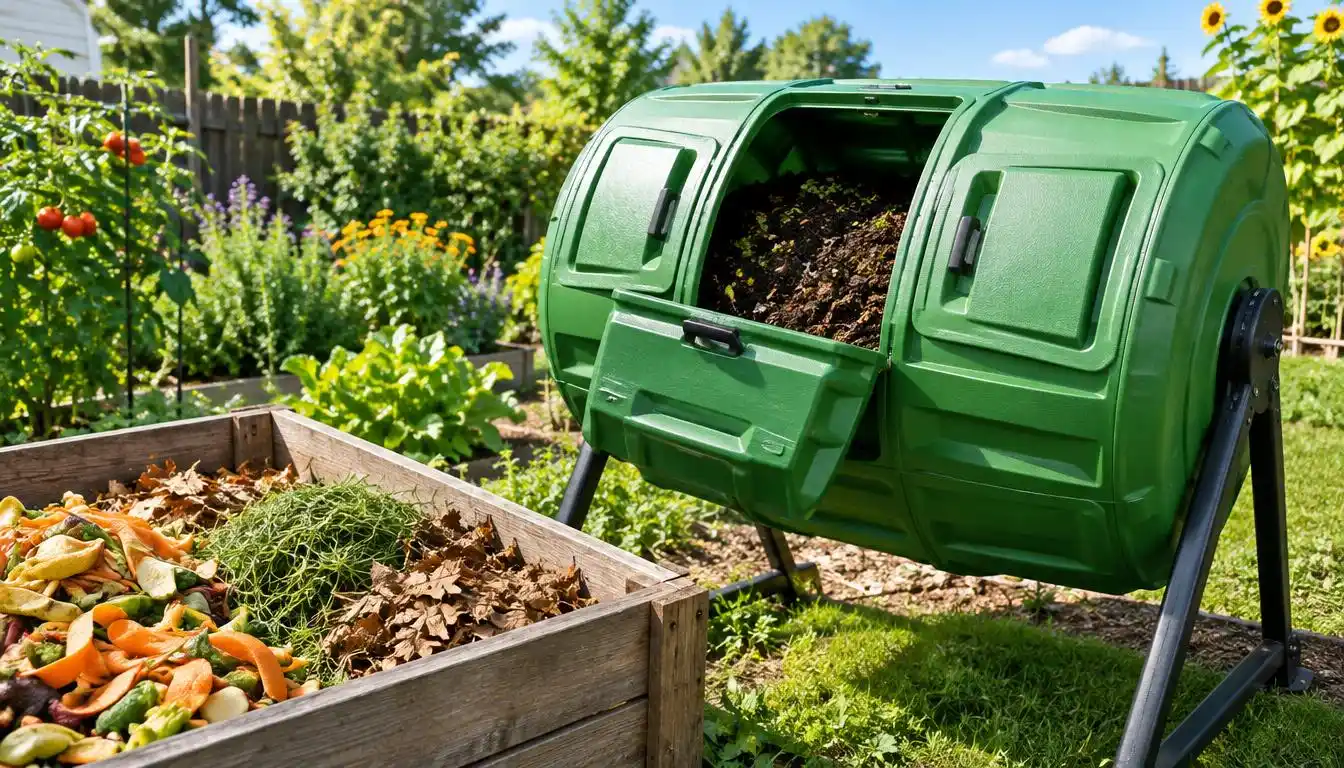
The RSI Maze 65-Gallon Compost Tumbler suits gardeners who want a large, easy-to-turn model for substantial yard waste. Your best fit still depends on household waste, yard size, and how much effort you want to spend turning and emptying. Aerobic composting is decomposition by organisms that use oxygen to break down organic waste.
This roundup identifies the best compost tumbler for several common needs, including small spaces, continuous composting, pest resistance, easy turning, and compost tea. Check the disclosure beside any affiliate links, if used, to learn about their relationship to the site.
Compare the individual picks first, then use the size and design criteria to match a model to your yard. That way, you can focus on the needs that matter most before choosing where it will sit.
Key Takeaways
- The RSI Maze 65-Gallon is the broad all-around pick.
- The FCMP rolling model suits modest waste and limited space.
- The Miracle-Gro offers a small raised design.
- Separate chambers help you keep batches at different stages.
- Check turning effort and access before buying a large model.
Best Compost Tumbler Overall
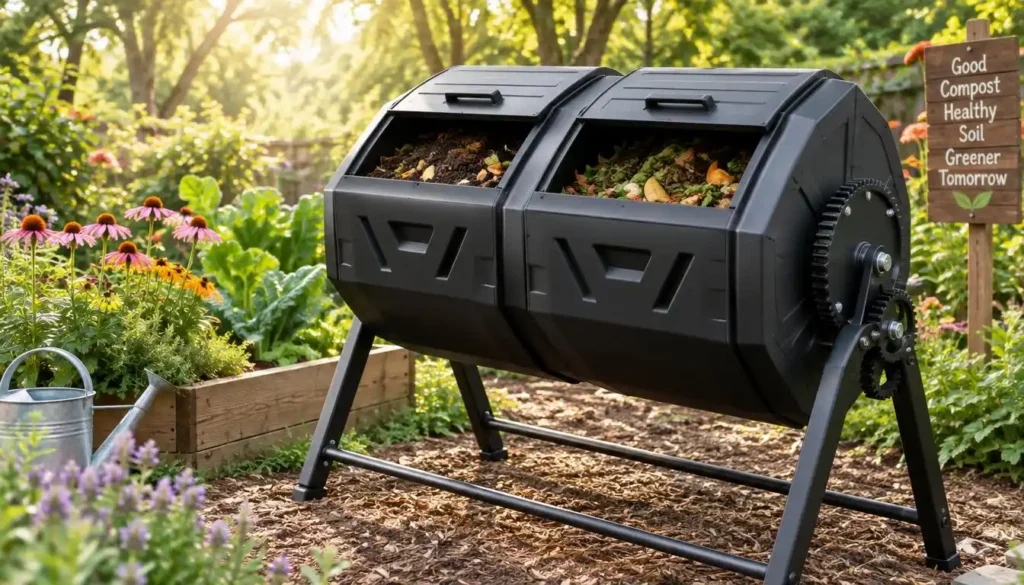
Choose the RSI Maze 65-Gallon for a medium or large garden with substantial yard and kitchen waste. Its two chambers let you manage separate batches, while the geared handle makes turning and positioning the barrel easier, even when loaded.
For many gardeners, this is the best compost tumbler 2026 because it pairs generous capacity with useful access. The crank helps move the barrel into position, and a ratchet lock holds it in place while you load or empty it.
The geared handle makes a large loaded barrel easier to turn and position, while two chambers support separate batches.
The barrel uses UV-protected, high-impact plastic, and the frame uses zinc-coated steel. Air vents on all sides support airflow, while large sliding covers give you room to add material.
Its 15 inches of ground clearance can make harvesting easier over a container or garden cart. Still, the 54-pound unit becomes difficult to move once full, and turning it may take both hands.
Its 65-gallon capacity works well when your yard creates more waste than a compact model can handle. If you need a lower-cost or smaller choice, consider the next picks.
Best Value for Small Composting Needs
A small patio or a household with modest organic waste may need only a compact, rolling tumbler. The FCMP Half-Size Rolling Composter keeps the footprint low and gives you a portable option for limited composting needs.
It holds 19 gallons and weighs 15 pounds, so you can move the empty bin without much effort. Its recycled, UV-inhibited, BPA-free polyethylene barrel has handholds, aeration holes, and internal fins that help mix scraps as it rolls.
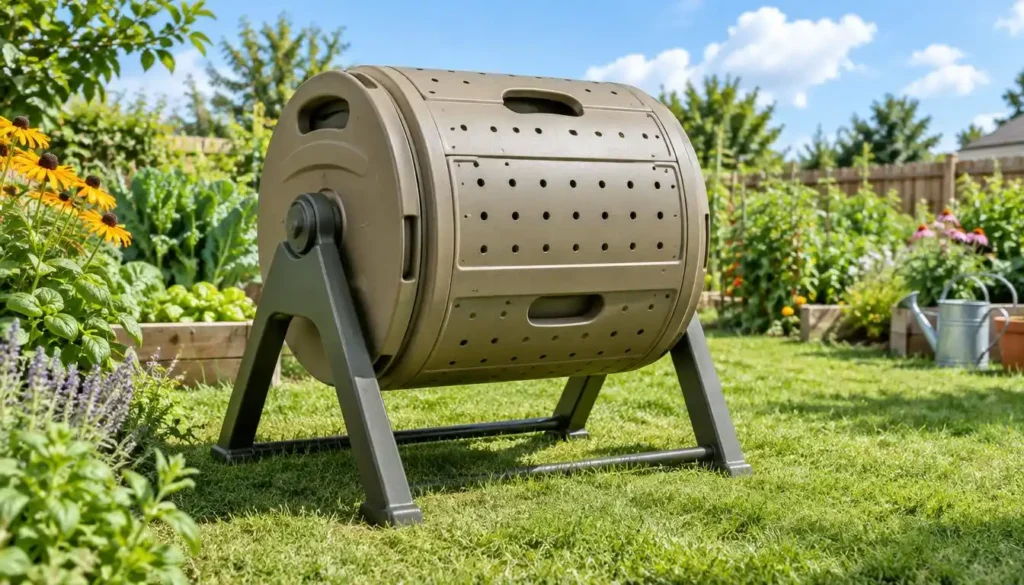
The maker recommends turning it about twice a day. That routine and its small capacity suit one or two people with modest compostable materials, but a large garden may fill it quickly.
The low rolling form has tradeoffs. The unattached stand can make turning awkward, and emptying means lifting the barrel to reach the compost.
For a small household, the low weight and compact size can matter more than a raised frame. If you want a raised frame and a barrel that is easier to rotate, look at the next small-space option.
Choose this tumbler for modest scraps, not recurring loads of yard waste.
Best Small Compost Tumbler
A small raised model can fit beside a patio or in a compact garden without taking up much ground space. The Miracle-Gro Tumbling Composter offers an 18.5-gallon chamber that one or two people can rotate with little effort.
Its hexagonal chamber has aeration holes and mixing bars. A powder-coated stainless steel frame supports the UV-protected plastic chamber, while rotation locks help keep it in place during loading and turning.
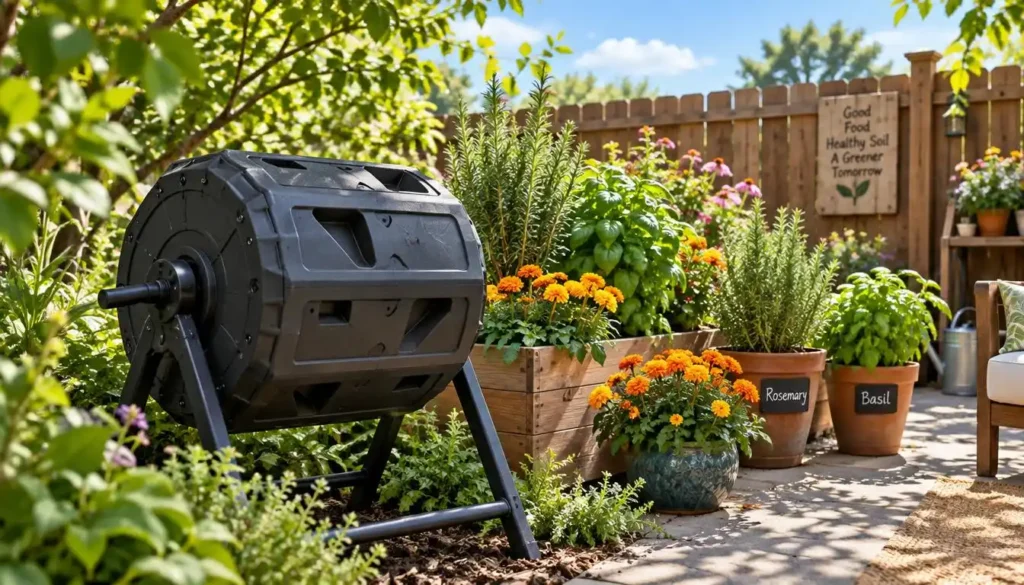
The unit weighs 10.6 pounds and measures 29.5 inches tall by 17 inches wide by 23.5 inches deep. A QR code links to assembly directions, which can make setup easier to follow.
The small chamber is easy to rotate, though its door feels tight when you load or remove material. Limited clearance under the frame also matters: use a shallow container when emptying.
Its small footprint suits a one- or two-person household with limited outdoor space. If you want to keep adding fresh material as another batch matures, consider a dual-chamber option.
Best for Continuous Composting
Separate chambers let you add fresh material to one side while the other batch matures. The RSI Maze 48-Gallon Two-Compartment Compost Tumbler suits gardeners who want an ongoing composting process without mixing new scraps into a batch already breaking down.
At 48 gallons, it has room for regular kitchen and yard inputs without the overall size of the largest pick. Its UV-protected barrel and galvanized steel frame support outdoor use.
A geared crank helps you turn the barrel, and sliding doors make adding material and harvesting manageable. You can keep one side active while the other rests, which helps stagger when each batch is ready.
Plan for a challenging assembly. Some parts fit tightly and may need force to seat, so take care as you put the frame together.
Its 26-pound weight makes it lighter than the overall pick, though a loaded barrel still takes effort to handle. For a mid-size geared model that also supports separate batches, consider the next option.
The two-compartment setup offers a clear way to manage different stages of composting without stopping new inputs entirely.
Best Compost Tumbler for Easy Turning
A gear handle can turn a barrel without requiring you to push it along the ground. The Black+Decker 40-Gallon Dual Chamber Compost Tumbler combines that approach with an elevated frame and access to two separate chambers.
Its oversized gear handle gives you leverage, and sliding doors let you add or remove material. The raised position can also make loading and emptying easier than working close to the ground.
Turning ease depends on the load, not just the handle. A full barrel, or one heavy with rainwater, takes more effort to rotate than an empty model.
Expect emptying to take time. The doors can slow access, and finished compost may need to be scooped out rather than poured freely.
The 40-gallon capacity offers a mid-size choice for gardeners who want separate batches. If secure access and pest resistance matter more than quick emptying, the next model may suit you.
Consider where you will stand while turning it, and whether you can reach the doors with a bucket or garden tool nearby.
Best for Rodent Resistance
Snug-fitting sliding doors make the Genesis 42-Gallon Dual Compost Tumbler the pest-conscious choice in this lineup. Its enclosed design can help limit access to scraps, though no tumbler should be treated as a guarantee against rodents.
The UV-resistant barrel sits on a powder-coated frame. Built-in mixing rods help move material as you turn it, while multiple ventilation points support airflow.
The compact footprint works well in a backyard where space is limited. Its 42-gallon capacity gives you room for a steady mix of kitchen and garden material.
The narrow doors make loading and removal less convenient. Scraps and finished compost may take more careful handling than they would with a wider opening.
This design balances contained access with everyday mixing features. If you want another dual-chamber pick, consider how its doors behave during rotation before settling on it.
Place the unit on a level spot with enough room to open its doors and turn the barrel comfortably.
Best Dual-Chamber Compost Tumbler
The Exaco 43-Gallon Recycled Plastic Compost Tumbler is a practical dual-chamber choice for gardeners who want staggered batches. One compartment can take fresh material while the older batch matures in the other.
Its steel two-leg stand raises the barrel and provides a stable base. At 28 pounds, it is a mid-size option for yards that need more capacity than a small household model offers.
Check that the doors are closed before turning. The access doors may slide open as the barrel rotates, so a quick check can prevent material from spilling.
For separate-batch gardening, this is a straightforward option that gives you room to manage fresh inputs and maturing compost. Its stand keeps the barrel raised, but the door behavior calls for attention.
The best dual chamber compost tumbler for you depends on how much you value batch separation, access, and a stable base. If you want to collect liquid alongside finished compost, consider the next pick.
Keep the area around the frame clear so you can reach both compartments without obstruction.
Best for Compost Tea
If you want to collect liquid beneath a composter, the Good Ideas 50-Gallon Compost Wizard Tumbler Kit has an integrated wheeled base for that task. The base collects compost tea as liquid drains from the compost.
The recycled plastic body has twist-off lids, and the kit arrives fully assembled. Its low profile can make it easy to place in a yard where a taller frame would be awkward.
Collected liquid does not replace checking the compost’s moisture balance. You still need to judge whether the contents feel suitably damp or too wet.
The 50-gallon barrel holds a substantial amount, but a full load can take considerable effort to rotate. Its 33-pound weight also makes placement worth planning before you fill it.
The liquid-collection base gives you a useful way to gather drainage for garden use. From product picks, move to a side-by-side look at capacity, dimensions, and weight.
How the Top Compost Tumblers Compare
Listed capacity alone does not show how manageable a loaded model will be. Compare each compost tumbler’s size and weight with the room you have to place and turn it.
Dimensions below follow height by width by depth. The figures help you check storage space and access, but they do not measure turning effort once a barrel is full.
| Model | Capacity | Dimensions | Weight |
|---|---|---|---|
| RSI Maze 65-Gallon Compost Tumbler | 65 gallons | 44.5 inches tall by 41.3 inches wide by 30 inches deep | 54 pounds |
| FCMP Half-Size Rolling Composter | 19 gallons | 24 inches tall by 12 inches wide by 24 inches deep | 15 pounds |
| Miracle-Gro Tumbling Composter | 18.5 gallons | 29.5 inches tall by 17 inches wide by 23.5 inches deep | 10.6 pounds |
| RSI Maze 48-Gallon Two-Compartment Compost Tumbler | 48 gallons | 43 inches tall by 36 inches wide by 25 inches deep | 26 pounds |
| Black+Decker 40-Gallon Dual Chamber Compost Tumbler | 40 gallons | 37.9 inches tall by 29.4 inches wide by 29.1 inches deep | 33 pounds |
Small capacity does not always mean the shortest or narrowest shape. Check the listed width and depth against gates, patios, and the space needed to open doors.
Use these measurements to narrow your shortlist. The next comparison explains how the picks were evaluated.
How We Evaluated These Tumblers
Eleven products were handled and used across an eight-week trial, rather than ranked from specifications alone. The test products cost $80-$300 and produced more than 100 pounds of compost.
The review considered how each composter worked through assembly, use, and movement. Each was loaded with wet and dry materials, including fruit and vegetable scraps, herbs, leaves, and grass.
- Assembly and instruction clarity
- Ease of turning and emptying
- Mobility when empty and full
- Build quality and value
Ratings reflect practical use as well as setup and construction. Assembly, ease of use, build quality, and value each received a score out of five.
| Model | Assembly | Ease of use | Build quality | Value |
|---|---|---|---|---|
| RSI Maze 65-Gallon Compost Tumbler | 5/5 | 5/5 | 4.5/5 | 5/5 |
| FCMP Half-Size Rolling Composter | 5/5 | 5/5 | 4.5/5 | 5/5 |
| Miracle-Gro Tumbling Composter | 5/5 | 5/5 | 4.5/5 | 5/5 |
| RSI Maze 48-Gallon Two-Compartment Compost Tumbler | 3.5/5 | 4.8/5 | 4/5 | 4.3/5 |
| Black+Decker 40-Gallon Dual Chamber Compost Tumbler | 4/5 | 4.3/5 | 4.3/5 | 4.2/5 |
The Genesis scored 4.5/5 for assembly, 4.5/5 for ease of use, 4.3/5 for build quality, and 4.3/5 for value. The Exaco scored 4/5, 4.2/5, 4/5, and 4/5 in those categories.
The Good Ideas scored 5/5 for assembly, 4.5/5 for ease of use, 4.8/5 for build quality, and 4.8/5 for value. The product lineup shown is not the full set of 11 tested products.
These results help you compare models. Next, match practical features to your own setup.
What Size and Chamber Setup Fits Your Yard?
Your weekly waste pattern is the best guide to capacity. The right size leaves you enough room for scraps without asking you to load or turn more than you can manage.
Choose the largest capacity you can realistically load and turn, not simply the largest available. Yard space and strength matter as much as volume.
Match Capacity to the Waste You Produce
A household that mainly saves kitchen scraps may produce a steady but modest stream of compostable materials. A compact model can suit that pattern, especially when you have little outdoor space.
Recurring grass clippings and dry leaves can fill a tumbler faster than kitchen scraps alone. If your yard produces seasonal piles of clippings, choose capacity with those larger inputs in mind.
Your usable capacity depends on the waste you generate and the work you can do. A full load may be harder to turn and empty, so match volume to your routine rather than buying by gallons alone.
Choose One Chamber or Separate Batches
A dual-chamber tumbler lets one batch mature while the other receives fresh material. That setup helps if you add scraps often and do not want to mix new waste into a batch nearing completion.
A single chamber keeps the design simple, but you need to pause new additions when you want that batch to finish. You can store new scraps elsewhere while the chamber rests.
| Situation | Priority | Practical choice |
|---|---|---|
| Mostly kitchen scraps | Compact capacity | Small model |
| Ongoing yard and kitchen waste | Room for staggered batches | Dual chamber |
| Limited strength or hard-to-reach placement | Manageable load and access | Smaller or easier-to-turn model |
Is a Used Compost Tumbler Worth Considering?
A used compost tumbler may suit you if you can inspect its parts in person. The barrel, doors, frame, and turning mechanism all affect how safely and smoothly it works.
Before you decide, check the following:
- Inspect the barrel for cracks.
- Check that doors close and latch.
- Confirm the frame and turning mechanism are stable.
- Verify that all parts needed for assembly are present.
Once size and batch plans fit your waste stream, the tumbler’s physical design affects how easily you can use it.
Which Tumbler Design Is Easiest to Use?
A rotating barrel on a stand keeps the tumbler raised, while a ground-rolling design moves along the ground. Your best choice depends on access, posture, and the space around the unit.
Think about where you will stand and reach before choosing a turning style. Loading and emptying can feel quite different across designs.
Ground-Rolling and Central-Axis Designs
Ground-rolling models move as you roll the barrel, while central-axis models spin around a midpoint axle. Handle-operated models use a crank to turn the barrel with controlled leverage.
| Design | How it turns | Best fit |
|---|---|---|
| Ground-rolling | The barrel rolls on a shaped base | Low placement and reduced wind exposure |
| Central-axis | The barrel spins around an axle through its midpoint | Easier standing-height loading and unloading |
| Handle-operated | A crank turns the barrel | Leverage and controlled positioning |
A low barrel may suit a sheltered spot, but a raised model can reduce bending when you load or empty it. The actual fit depends on your reach and available space.
Compost Tumbler vs. Bin
A compost tumbler encloses material in a vented barrel that you rotate to add oxygen. A stationary bin or compost pile does not rotate, so you must aerate it another way.
The tumbler offers more containment, which can help keep material together in a defined space. It also asks you to turn the load by hand, while a stationary setup may need a fork or other method to mix it.
When you compare compost tumbler vs bin options, consider how much hands-on work you want. A bin or pile may suit a larger yard or a setup where you do not need a rotating barrel.
Is a DIY Compost Tumbler Practical?
Plans for a compost tumbler DIY project exist, but safe build specifications are not established here. Homemade rotating containers need stable support and secure access.
Do not guess at the structure. Check stability, ventilation, and secure access before using any homemade design, rather than relying on untested instructions.
From design choice, move to the everyday steps that keep your tumbler working.
How to Use a Rotating Compost Bin
A rotating bin needs balanced inputs, suitable moisture, and regular turning. Learning how to use a rotating compost bin starts with what goes in and how the batch feels.
Small pieces break down faster than large pieces. Cutting material into smaller bits helps the decomposition process move through the batch more evenly.
Use this sequence to start a batch:
- Combine green and brown materials.
- Keep the contents damp rather than saturated.
- Turn the barrel to mix material and introduce oxygen.
- Stop adding fresh material when you want a batch to finish.
Load Green and Brown Materials
Green materials include fresh scraps and grass, while brown materials include dry plant matter. A workable mix gives the composting microbes both types of material to break down.
Keep the contents damp, not soaked. Too much water can crowd out airflow, while a dry batch may slow as microbes lose the moisture they need.
Turn the Batch Without Losing Heat
Turning moves microbes through the material and adds oxygen. It also mixes damp and dry areas, which helps the batch break down more evenly.
More turning is not always better. Excessive turning can disperse heat, so use a steady routine rather than spinning the barrel whenever you pass it.
No single finish time applies to every climate, mix, or tumbler. The decomposition process depends on the materials and conditions inside your barrel.
Next, sort out which ingredients belong in a batch and which should stay out.
What Should You Put in a Compost Tumbler?
Fresh, moist inputs and dry plant material play different roles in compost. Fruit and vegetable kitchen scraps supply nitrogen, while dry leaves add brown material.
Use a mix of fresh greens and dry plant matter. The tested materials included fruit and vegetable scraps, herbs, leaves, and grass.
Useful Green and Brown Ingredients
Fresh kitchen scraps, herbs, and grass clippings count as green material. These inputs supply nitrogen, which helps support the organisms that break down organic waste.
Dry leaves contribute brown material. They also add structure among moist scraps, so the batch has a mix of materials rather than a dense layer of food waste.
Materials to Keep Out
Knowing what not to put in a compost tumbler helps you avoid unsuitable inputs and unwanted problems. Keep these materials out:
- Meat, fat, dairy products, fish, and bones
- Pet droppings
- Twigs and woody prunings
- Material treated with pesticides, herbicides, or fertilizers
- Any material you cannot confirm is safe for the garden
When you are unsure about a material, leave it out rather than risk using unsuitable compost on your soil. Choose familiar garden and kitchen inputs you can identify.
From choosing ingredients, move to diagnosing a batch that is too wet, smelly, or slow.
How Can You Fix a Slow or Smelly Tumbler?
Most slow or smelly batches need a correction to air, moisture, particle size, or the mix. A soggy batch can become airless and develop an unpleasant smell.
Start by checking moisture and airflow before changing several things at once. Heavy rain can add unwanted water to a tumbler left exposed outdoors.
Correct Excess Moisture and Odor
If the contents feel soggy, add dry leaves or shredded newspaper to absorb moisture. Check that vents remain open and that material has not packed tightly against them.
A sour or foul smell can point to poor airflow or too much water. Make one change at a time, then check whether the batch becomes less wet and easier to aerate.
Heavy rain may raise moisture even when your original mix felt right. If the unit sits in an exposed place, consider how rain reaches its openings and doors.
Help a Slow Batch Decompose
Large pieces, an unsuitable green-to-brown balance, low moisture, and weak aeration can slow decomposition. Chop or shred oversized material, then reassess the mix.
If the contents are completely dry, add a small amount of water and mix it through. Turning also helps bring material and microbes together, but too much turning can dissipate heat.
Use these signs to choose a first adjustment:
- Sour or foul smell: check airflow and excess moisture.
- Muddy contents: add dry material.
- Dry contents: add a small amount of water and mix.
- Slow breakdown: reduce particle size and reassess the green-brown mix.
There is no universal number of weeks for a finished batch. Climate, moisture, materials, and airflow all affect the process.
Correct air, moisture, particle size, or the mix before chasing a fixed finish date.
Careful adjustments and a realistic next step matter more than a fixed schedule. Use what the batch shows you to choose the next change.
Conclusion
The best choice matches the capacity and turning effort to your actual routine. The RSI Maze 65-Gallon is the broad all-around option for a medium or large garden.
For small spaces, consider the compact FCMP or Miracle-Gro. Each can suit a lighter waste stream without taking up the space of a larger model.
Before you buy, estimate your kitchen and yard waste, then check that you can load, turn, and empty your choice. Measure the waste stream and check the available placement.
FAQ
What is the best compost bin?
The best compost bin depends on your space and how much waste you produce. An enclosed tumbler suits you if you want contained, turnable batches and can manage the turning effort. A stationary bin or compost pile may fit a larger yard or a routine that does not call for a rotating barrel. Consider access, space, and how you plan to aerate material.
Does a compost tumbler work?
Yes, a compost tumbler works when the contents have suitable moisture and airflow and you turn them to mix in oxygen. It can keep material contained while you manage a batch. Results vary with climate, materials, moisture, and aeration, so no single completion time fits every tumbler. Check the contents and adjust the mix as needed.
How do I speed up my compost tumbler?
Use smaller pieces, a workable green-brown mix, adequate moisture, and regular turning to help your compost tumbler. Oversized pieces take longer to break down, and excess water can limit airflow. If the contents feel dry, add a little water and mix it through. Avoid turning so often that you disperse heat from the batch.
How often should I pee on compost?
There is no fixed schedule for adding urine to compost, and urine is not required. Keep your attention on a balanced mix of green and brown materials, suitable moisture, and enough airflow. If your compost already feels wet, adding more liquid can make conditions worse. Check the texture of the batch and adjust based on what it needs.
What is the best compost tumbler?
The RSI Maze 65-Gallon Compost Tumbler is the all-around pick for medium and large gardens. Its capacity suits substantial yard and kitchen waste, and its geared handle helps you turn and position the barrel. The tradeoff is its weight: once full, it can be difficult to move. Choose a smaller model if you expect to relocate it often.
What is the disadvantage of a compost tumbler?
A compost tumbler has less capacity than a large compost pile, and it needs regular turning. A full or rain-heavy load can take effort to rotate, especially if the model has a large barrel. Access doors can also make loading or emptying slower. Check the turning method and how you will remove finished compost before choosing one.
Can I put banana peels in my compost?
Yes, banana peels are fruit scraps and can go into a compost tumbler. Cut them into manageable pieces so they mix more easily with the rest of the batch. Balance moist kitchen waste with dry plant material, such as dry leaves. That mix helps keep the contents from becoming a dense layer of wet food scraps.