
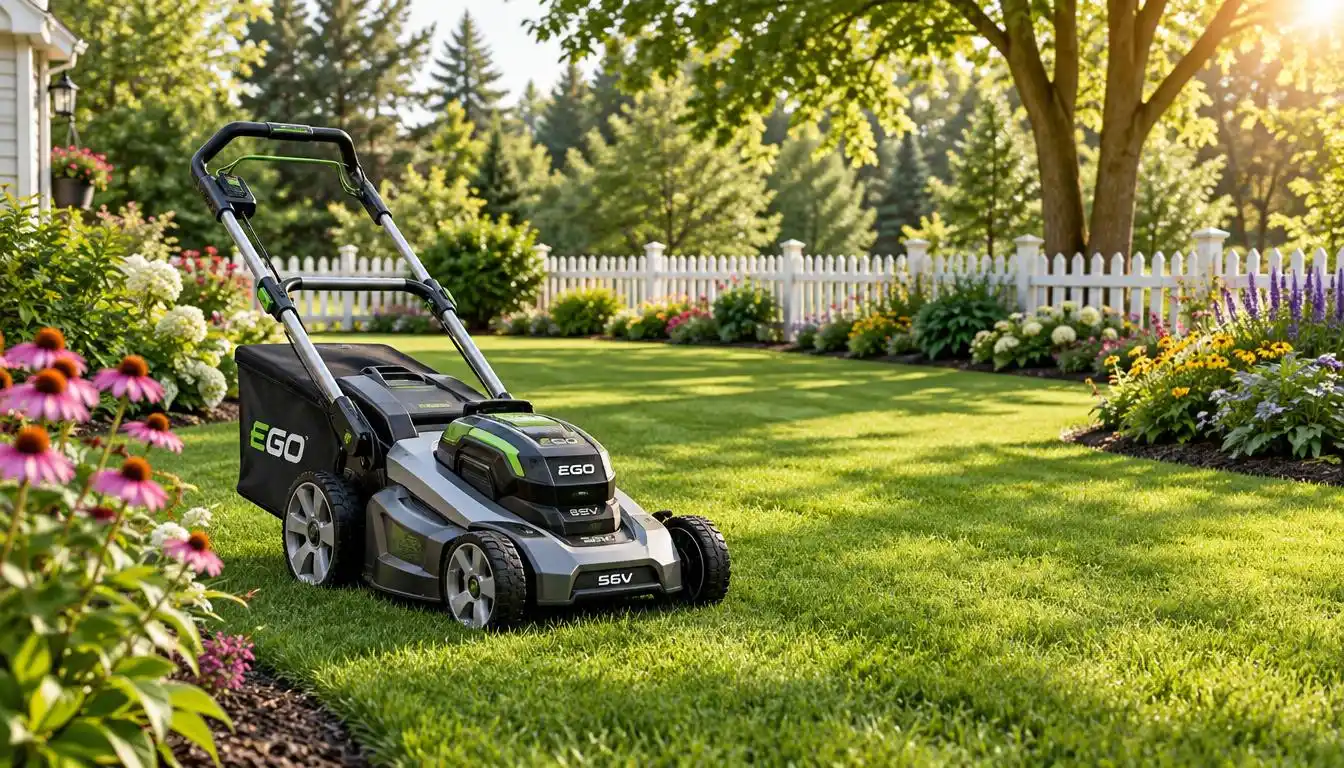
The right pick depends first on your yard and how you mow it. A small, flat lawn calls for different features than a broad yard with slopes, thick grass, or many tight turns.
Runtime means the number of minutes a mower can cut on a charged battery before it needs a recharge or a battery change. Lawn area, terrain, your preferred effort, and batteries you already own all affect the choice. A useful pick balances cut quality, convenience, and value instead of chasing the longest specification.
Your time matters, too. A wider deck can cover open ground faster, while a compact mower may save effort around beds and trees. Price also depends on whether the kit includes a battery and charger, so compare what you receive before judging the money involved.
Key Takeaways
- Match mower size and drive style to your lawn’s area and terrain.
- Compare cut quality, convenience, kit contents, and price together.
- Check battery compatibility if you already own yard tools.
- Account for slopes, tight turns, and the pushing effort you accept.
- Choose useful runtime for your lawn, not a high number alone.
The shortlist starts with five walk-behind models for different needs, then moves to advice on choosing a type and setup that fits your yard.
Which Cordless Mowers Should You Shortlist?
The best shortlist changes with yard size and mowing priorities. Start with fit: these five U.S.-tested models cover all-around performance, value, compact handling, demanding lawns, and push-mower use.
There is no verified pick under $200 among these U.S. comparisons. Check whether a listing sells a bare tool or a complete kit, since a model name alone does not confirm that its battery and charger are included.
There is no verified under-$200 pick here, and a bare tool is not a complete kit.
| Model | Best-fit priority | Drive style |
|---|---|---|
| EGO Power+ Select Cut | Overall performance | Self-propelled |
| Ryobi 40V HP 21-inch | Value | Self-propelled |
| Litheli Easysurge 18.5-inch | Compact yards | Push |
| Milwaukee M18 Fuel 21-inch | Demanding larger lawns | Self-propelled |
| Echo 56V 21-inch | Push-mower option | Push |
If you are choosing the best cordless lawn mower in 2026, compare the exact kit, current price, and local availability. Those details can change, so a model’s place on this list does not promise a specific deal or stock status.
The phrase best cordless lawn mower with battery and charger is useful when you shop, but read the kit details closely. Some models may come in more than one package, and the listing determines what comes in the box.
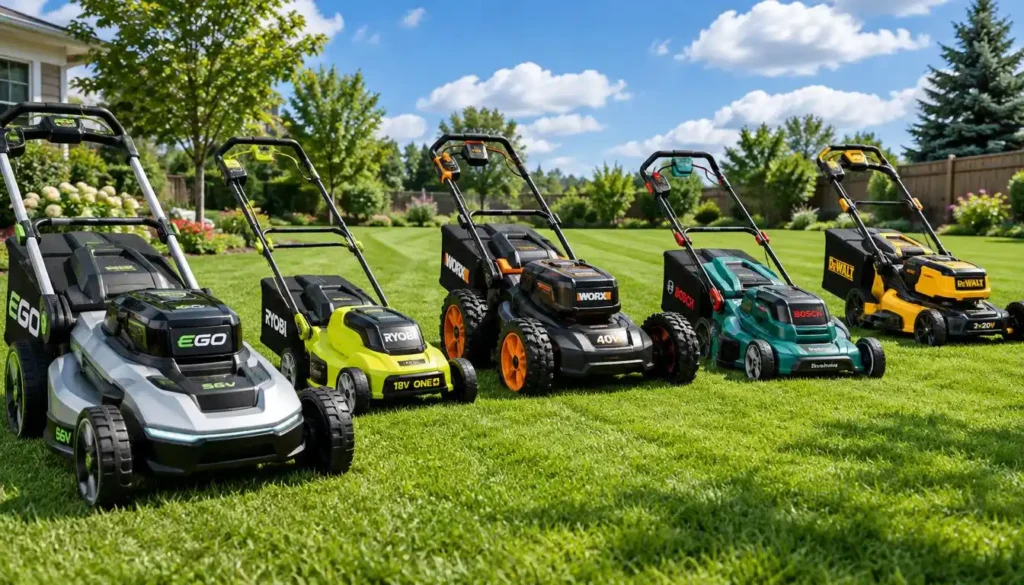
For the strongest all-around starting point, read the EGO review first. Then compare the value, compact, heavy-duty, and push options against your own yard and mowing habits.
Is the EGO Power+ Select Cut the Best Overall Pick?
The EGO Power+ Select Cut LM2135SP is the strongest all-around pick when cut quality and adjustable mowing matter most. Its flexible blade setup lets you tune the cut for different jobs.
The 21-inch mower earned 5/5 for cut quality and runtime, with 4.9/5 for ease of use. It also earned 5/5 for noise and 4.7/5 for value. In the tested kit, runtime and recharge time each measured 60 minutes.
How its blade system adapts to different mowing jobs
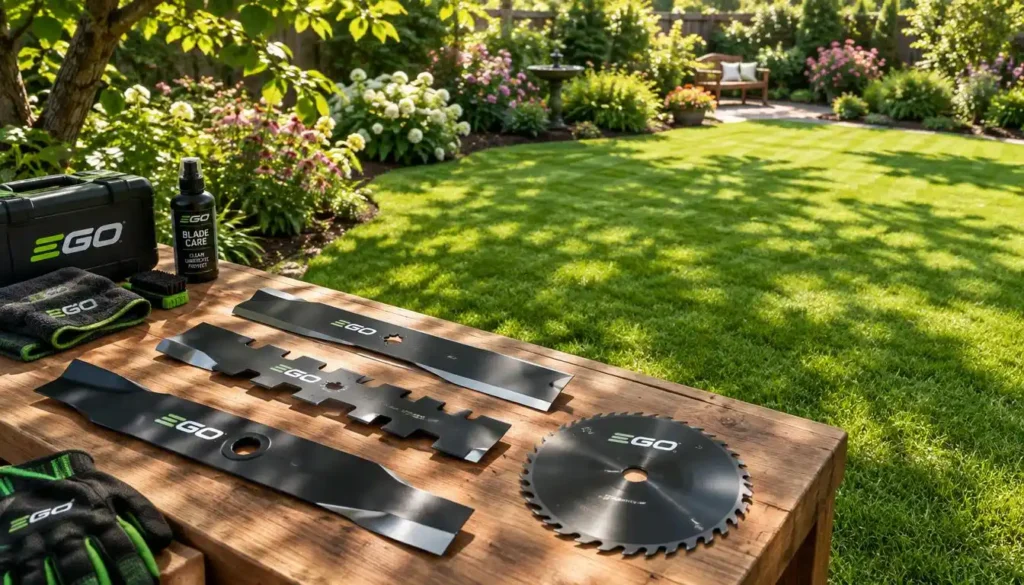
The dual-blade system uses interchangeable lower blades for mulching, bagging, or longer runtime. Choose the mulching blade when you want fine clippings returned to the lawn.
The high-lift bagging blade moves more grass into the catcher. The extended-runtime blade favors longer mowing between charges, though the best choice depends on your grass and cutting plan.
Switching blades gives you a way to change the mower’s focus, rather than settling for one blade style. That choice can matter when your lawn alternates between thick growth and routine trims.
What the drive controls and bagging setup mean for you
TouchDrive pairs a speed dial with switches in the hand grips. Set a pace that feels comfortable, then use the grip controls to engage the self-propelled mower.
The mower makes a strong, even cut, and its controls keep speed changes close at hand. The grass catcher is undersized for large lawns, so you may need frequent stops to empty it.
Choose this EGO when its feature set and cut quality justify the price, and the bag capacity suits your lawn. If you want stronger value for a suburban lot, consider the Ryobi.
Does the Ryobi 40V HP Offer the Best Value?
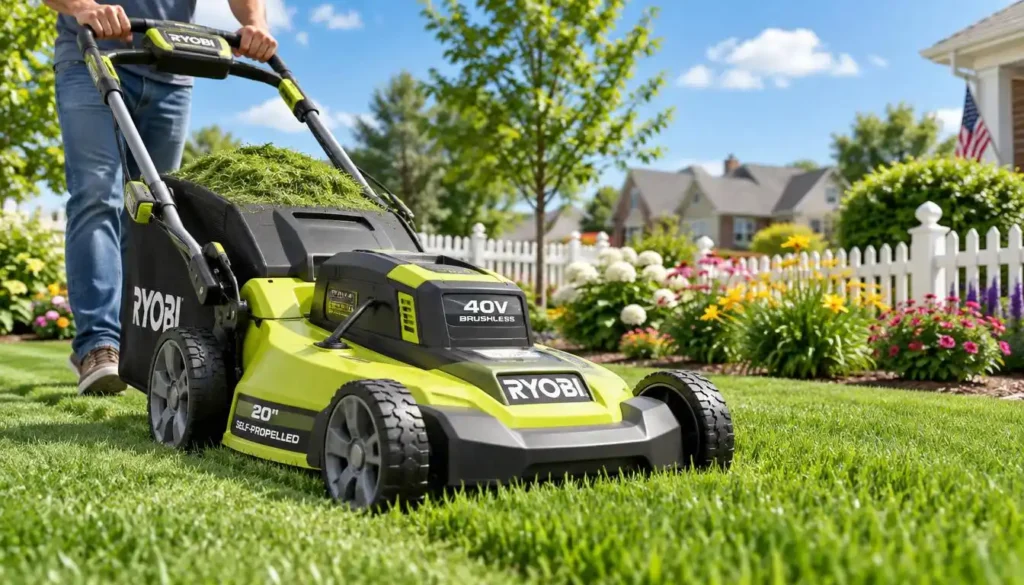
The Ryobi 40V HP 21-inch self-propelled mower is a strong value choice for a midsize suburban lawn. Its useful kit pairs two batteries with features for regular home mowing.
The kit includes two 6.0Ah batteries and lists up to 80 minutes of runtime. Its listed recharge time is 100 minutes, and the mower can cover about 0.75 acre under the stated conditions.
A two-stage brushless motor supplies cutting power, while three-way clipping management lets you bag, mulch, or discharge grass. A single-lever height adjustment makes it easier to set the cut without changing each wheel separately.
The two batteries give you more capacity in the kit, which can help on a typical suburban lot. The self-propelled drive also cuts down on pushing effort over longer passes.
The price is described as under $500, but that is not a current retailer quote. Check the listed price and included kit when you shop, and compare the full package rather than assuming this is the cheapest mower.
For an average lot, this balance of power, battery capacity, and clipping features makes a practical value case. Many tight turns and obstacles may call for a smaller mower, such as the compact Litheli.
Which Mower Suits a Small, Obstacle-Filled Yard?
If you spend more time steering around garden beds, trees, and tight turns than crossing open grass, the Litheli Easysurge deserves a look. Its compact size can make a crowded lawn easier to manage.
The 18.5-inch deck suits smaller spaces, but small wheels make rough ground and steep areas harder to handle. Compact handling does not mean the mower can manage every kind of terrain.
The mower has four 20V, 4.0Ah batteries in its kit. Its listed runtime is 100 minutes, but listed recharge time is 240 minutes, a long wait if you rely on the same batteries for repeated sessions.
A blade speed of 4,500 rpm supports cutting, and a button controls the cutting-height adjustment. You can choose mulching, bagging, or side discharge, depending on what your lawn needs and the included setup.
The four batteries can also serve as USB power banks. That extra use may appeal if you need portable power, though it does not change the mower’s limits on bumpy or steep ground.
Pick it when maneuverability matters more than covering a broad, rough area. If your lawn is open and demanding rather than compact, look at the higher-power Milwaukee option.
Can the Milwaukee M18 Fuel Handle a Large Lawn?
The Milwaukee M18 Fuel is a capable option when strong cutting power and a rugged deck matter. Its heavy-duty build aims at larger lawns and tougher grass.
The 21-inch steel deck and two-battery setup deliver 36V operating power from two 18V, 12Ah batteries. Listed runtime is 60 minutes, with both batteries used at once.
Where its steel deck and blade speed help
The steel deck gives the mower a solid feel, while strong airflow helps move cut grass. High-lift mode reaches 3,300 rpm to support bagging and cutting through heavier growth.
Standard mode runs at 2,800 rpm and uses less blade speed. You can favor stronger airflow with high lift or choose the standard setting for routine mowing.
The mower is described as delivering more torque than a 200cc gas mower. That comparison speaks to its cutting strength, but it does not tell you how the mower will perform in every lawn condition.
What to weigh before choosing this heavier-duty mower
Both batteries power the mower simultaneously, so you need the pair ready for a mowing session. This setup and the mower’s premium positioning may suit you if strength and construction rank high.
The listed recharge time conflicts: the specifications say 90 minutes, while the product description says two hours. Do not choose a single figure by guessing; check current manufacturer information for the exact kit.
Choose it if you value power and a rugged deck enough to accept its premium position. For a simpler, non-self-propelled design, the Echo push mower offers another route.
When Is a Push Mower the Better Choice?
On a mostly level lawn, a push mower can spare you the cost and added drive parts of a powered mower. The Echo 56V push mower is a straightforward option if you are comfortable providing the push.
It has a 21-inch deck, weighs 70 pounds, and lists 140 minutes of runtime. Its listed recharge time is 150 minutes, and it comes with two batteries.
The Echo’s balanced high-wheel design helps it move over the lawn, and it delivers a clean cut. Its motor raises power in taller or thicker grass, which can help when growth is uneven.
At 70 pounds, the mower may feel substantial when you lift it or push it through a long session. The wheel design helps with maneuvering, but it cannot remove the effort of moving the mower yourself.
The mower uses one battery at a time and switches to the second automatically when the first runs out. That sequence can reduce downtime, since you do not need to stop to change batteries during the switch.
Choose a push mower if your lawn is mostly level and you prefer a simple drive system. If hills or uneven ground make pushing hard, consider a self-propelled option.
Which Self-Propelled Mower Handles Hills Best?
A sloping lawn can make it hard to keep traction and control, especially when you turn or cross uneven ground. The Ryobi 40V HP AWD is a hill-focused option with switchable drive.
Testing covered slopes up to and beyond 45 degrees without slipping, but that result does not promise the same grip on every yard. Surface, grass, and weather can change traction.
The mower has a 21-inch deck, uses two batteries at once, and lists 75 minutes of runtime. It switches between two-wheel drive and all-wheel drive, so you can reserve added traction for the difficult parts.
Its adjustable pace lets you set a comfortable speed, while LCD controls show the mower’s settings. Using two-wheel drive on easier ground can help conserve battery power, then all-wheel drive can help where traction becomes a concern.
For shoppers seeking the best self-propelled cordless lawn mower for slopes, this model is a strong category example. Its listed recharge time is 120 minutes, but a different lawn or pace can affect how useful that schedule feels.
Consider it when a self-propelled mower and added traction fit your terrain. If your property is too large for a walk-behind mower, a riding option may make more sense.
When Does a Riding Mower Make Sense?
A riding mower becomes relevant when a walk-behind would make a large property too laborious to mow. More coverage per pass can save effort across a broad area.
The EGO Power+ Z6 is a 42-inch zero-turn riding mower described as covering up to 2 acres per charge. Its six onboard battery slots let you carry a larger battery setup.
What the EGO Z6 offers on a large property
The Z6 includes four 56V, 10Ah batteries and has six battery slots. Its listed runtime and recharge time are each 120 minutes with four batteries.
The mower’s top travel speed is 7 mph, and its stated mowing rate is 2.6 acres per hour. Zero-turn controls help you steer around objects, though speed and capacity do not remove the need to plan a safe route.
The 42-inch deck covers more ground than a walk-behind deck. That size makes it better suited to a broad property than a small lawn with narrow gates or tight spaces.
Space, batteries, and the long-term ownership decision
A riding mower takes room to store and represents a substantial purchase. It is not a practical substitute for a walk-behind mower when your lawn is small.
The EGO Z6 product information says its batteries may need replacement in 5 to 10 years. Treat that range as a possible future cost, not a fixed replacement date.
If you mow a large property, riding may save considerable effort. For walk-behind buyers who care most about mulching, a separate EGO model has a cast-aluminum deck.
What Makes the EGO Aluminum-Deck Mower a Strong Mulching Pick?
The EGO Power+ 22-inch Select Cut is the EGO pick with a cast-aluminum deck and no side-discharge option. Its mulching focus stands apart from the other EGO models here.
Its stacked blades and high airflow support mulching and bagging, but you cannot choose side discharge. That limit matters if you often want to spread clippings across the lawn.
This model uses a 56V, 10Ah battery, with listed runtime of 70 minutes and recharge time of 60 minutes. Its blade speed reaches 3,350 rpm, and its stated torque is just over 11 foot-pounds.
Three blade speeds let you adjust the mower’s cutting action. The stacked blade design supports a clean cut and moves clippings through the mower for mulching or bagging.
The cast-aluminum deck is the key construction feature. Buyers who need side discharge should compare another model, since this one does not offer that mode.
Keep this model distinct from the LM2135SP: they are separate mowers with different designs and specifications. Next, use your yard’s size and shape to narrow the mower type and deck width.
How to Choose the Best Cordless Lawn Mower for Your Yard
A mower should fit your lawn’s shape and terrain as well as its area. Start with the ground, then choose a deck and mower type that you can manage.
Walk-behind battery mowers suit lawns smaller than an acre; larger acreage calls for a battery-powered riding mower. That is a broad guide, not a precise cutoff for small and medium lawns.
| Yard situation | Example deck width and mower type | Practical trade-off |
|---|---|---|
| Compact or obstacle-heavy yard | 18.5-inch walk-behind | Easier turns, more passes |
| Typical residential walk-behind choice | 21-inch walk-behind | Balance of reach and handling |
| Larger property | 42-inch riding mower | More coverage, more storage space |
The compared walk-behind examples use 18.5-inch and 21-inch decks, while the riding example has a 42-inch deck. The best cordless lawn mower for your yard depends on gates, trees, slopes, and open stretches, not just lawn area.
There are no precise square-foot thresholds here for small or medium lawns. The broad distinction is smaller than an acre for walk-behind use and larger acreage for a riding mower.
- Lawn area and the time you want to spend mowing
- Slope and rough patches that affect traction
- Narrow gates, trees, beds, and other obstacles
- How much pushing effort you accept
A best lightweight cordless lawn mower should be judged by total machine weight and maneuverability, not deck width alone. A narrower deck may turn more easily, but it does not prove the full mower will feel light.
Choose the size that suits the yard you actually mow. Once that fit is clear, compare the battery setup with the work your lawn requires.
How Much Runtime Can You Expect From a Battery Mower?
Many battery mowers average about 45 to 50 minutes of runtime, while some reach 70 minutes or more. Your actual mowing time depends on the lawn and how you use the mower.
Compare the listed runtime with your workload, not as a promise of identical minutes in every yard. Thick grass, slopes, self-propelled drive, and mowing pace can all reduce usable time.
Why the same battery lasts longer on some lawns
Short, dry grass is often easier to cut than tall or dense growth. Steeper ground also asks more of the mower, and powered drive uses energy as it moves you forward.
A slower pace can help you keep a steady cut, while rushing through thick grass may make the motor work harder. Your lawn’s area matters, but grass conditions and terrain shape the battery’s workload.
How extra battery capacity changes the mowing plan
A spare battery can reduce interruptions if one runs low before you finish. Some models have multiple battery slots, allowing a second battery to take over when the first is depleted.
The table shows listed figures, not guaranteed mowing results. Check what the kit includes, since extra capacity may depend on the package you buy.
| Model | Listed runtime | Listed recharge time | Practical note |
|---|---|---|---|
| EGO Select Cut | 60 minutes | 60 minutes | Tested kit figures |
| Litheli Easysurge | 100 minutes | 240 minutes | Long recharge time |
| Echo 56V push mower | 140 minutes | 150 minutes | Two batteries included |
| Ryobi 40V HP AWD | 75 minutes | 120 minutes | Uses two batteries |
- Compare runtime with your lawn’s area.
- Account for tougher grass and slopes.
- Check whether the kit includes a second battery.
Battery capacity is only part of the plan. Drive type changes both your effort and energy use, so compare push and self-propelled choices next.
Should You Choose a Push or Self-Propelled Mower?
A push mower leaves the work of moving the mower to you, while a self-propelled mower provides powered drive. Your terrain and effort should guide the choice.
Powered drive can reduce effort on slopes and longer routes, but it adds mechanical weight and uses battery power. A push mower avoids powering the wheels and gives you direct control of pace.
On a flat, short route, pushing may feel simple and keep the mower’s setup less complex. On a long or sloping lawn, powered drive may make mowing easier to manage.
- Lawn slope and how much traction the mower needs
- Total mowing distance and the length of each session
- Mower weight when turning, lifting, or storing it
- Whether reduced runtime with drive engaged is acceptable
A self-propelled mower can help you keep a steady pace when the ground rises or the route stretches across the yard. It may also weigh more, so consider how you will move it when the drive is off.
A push model can suit you if you want to set your own pace and do not mind providing the force. Your strength and comfort matter as much as the mower’s listed features.
Once you know which drive style fits, decide what should happen to the clippings. The right cutting mode depends on how you want to handle them.
Which Cutting Mode Fits Your Grass and Clippings?
Choose a cutting mode based on whether you want to collect clippings, return them to the lawn, or discharge them. Check the exact mower, since not every model offers every mode.
Match the mode to your grass and cleanup plan, and confirm the mower includes the needed parts. A model’s listing should say which clipping options it supports.
- Bagging collects grass in a catcher for disposal or composting. Check whether the mower includes a grass catcher.
- Mulching cuts grass into small pieces and returns them to the lawn. Check that the mower has a mulching blade or setting.
- Side discharge sends clippings out through a side opening. Check for a discharge chute and confirm that the model offers this mode.
- Cylinder mowing uses a reel-style cutting action for short, maintained grass. It is not intended for long, overgrown growth.
Bagging can keep clippings off the lawn, but it means emptying the catcher as it fills. Mulching returns fine cut grass, while side discharge leaves clippings on the lawn in a spread-out path.
The EGO 22-inch aluminum-deck mower supports mulching and bagging but has no side-discharge option. If you need to discharge clippings, choose a model that clearly lists that feature.
Grass height also matters. A cylinder mower works best on short, maintained grass, not an overgrown lawn that needs a rough first cut.
After choosing a clipping setup, look at ownership details. Battery compatibility, cost, and upkeep can change which mower offers the best fit.
Can One Battery Platform Power Your Other Yard Tools?
Start by asking whether a battery you already own can power the mower you are considering. Shared batteries can add value when the tools truly use the same system.
A shared brand name does not guarantee that every battery fits every tool. Check the exact platform, voltage, and model match before you count an existing battery as part of the mower kit.
What battery compatibility across outdoor tools means
Many mower makers offer shared battery platforms for outdoor tools, often at 40V or higher. DeWalt, Makita, and Milwaukee also offer mower systems using 18V or 20V batteries shared with hand tools.
| Platform type | Tool examples | What to verify |
|---|---|---|
| 40V-or-higher outdoor-tool platforms | String trimmers, leaf blowers, chainsaws | Voltage and fit for each tool |
| 18V or 20V platforms | Drills, circular saws | Exact mower battery system |
| Mower and other-tool systems | EGO, Greenworks, Hart, Kobalt, Ryobi, Stihl, Worx | Tool and battery model match |
Some systems link outdoor tools, while others share batteries between mowers and hand tools. A battery that fits your drill may not suit a mower from the same brand.
How to compare a brand ecosystem without assuming a winner
Compare the exact mower, battery kit, charger, and tools you plan to run. A lower mower price may not help if you need to buy batteries and a charger separately.
Greenworks cordless lawn mower and Worx cordless lawn mower options should be judged by the exact mower, included batteries, and compatibility you need. The facts here do not support ranking a Greenworks model against EGO.
Gasoline and maintenance savings may offset a higher upfront price within a few years. The amount depends on your use and costs, so do not assume one fixed savings figure.
Bring battery compatibility into your final ownership check. Then weigh the upkeep and trade-offs that come with battery power.
What Upkeep and Trade-Offs Come With Battery Mowers?
Battery mowers reduce gas-engine upkeep but do not remove ownership tasks. You still need to care for the blade, battery, and charger.
Battery models produce no direct exhaust and are quieter than gas models, but replacement batteries can become a future cost. They also need less maintenance than gas mowers.
- Keep the blade in suitable condition for a clean cut.
- Follow the battery and charger instructions for care and charging.
- Plan for eventual battery replacement as the mower ages.
Battery mowers do not use fossil fuels during mowing. You avoid engine upkeep, though you still need to follow the maker’s care instructions and keep the cutting parts in good shape.
The EGO Z6 product information gives a possible battery replacement period of 5 to 10 years. That range applies to that product information, not every brand or battery.
Bring the decision back to yard fit, compatible batteries, and how much effort you want to spend mowing. Those points lead to a practical final choice.
Battery mowers cut engine upkeep, but you still need to care for the blade and battery.
Conclusion
There is no single mower suited to every backyard. Let lawn size and terrain determine the mower type, then weigh cut quality, effort, and value against your needs.
An existing compatible battery platform can improve value, but only if the mower uses batteries you own. Check the exact kit contents and battery compatibility before buying.
Measure your lawn, then check which batteries and charger come with the model you are considering.
FAQ
Is Greenworks or Ego better?
Neither brand is a supported universal winner; compare the exact mower’s cut, yard fit, battery kit, and tool compatibility. A Greenworks model may suit your lawn better, while an EGO model may fit another buyer’s needs. Check deck size, drive style, included batteries, and charger. If you already own outdoor tools, confirm their batteries fit the mower before weighing the price.
What lawnmowers do professional gardeners use?
Professional gardeners do not all use one standard mower. Their choice depends on lawn size, terrain, workload, and the type of finish a job needs. A push mower may suit a small, level area, while a self-propelled model can help on slopes or long routes. A riding mower may fit a large property where a walk-behind would take too much labor.
What is the best push mower in 2026?
The Echo 56V 21-inch push mower is the push pick in this roundup. Its listed runtime is 140 minutes, and it uses two batteries in sequence, with an automatic switch when the first runs out. The mower weighs 70 pounds, though its high-wheel design helps with movement. Consider that weight and your lawn’s terrain before choosing it for a long mowing session.
Which brand of outdoor power tools is considered the best?
There is no universal best brand in these product facts. Choose based on the exact mower’s performance, your yard, and whether its battery platform fits tools you already own. Compare the included batteries and charger, too. A brand with a wide tool range may offer value if you use several compatible products, but check each battery and model match.
What is the best brand of battery-powered lawn equipment?
No single brand is best for every buyer. Compare EGO, Greenworks, Ryobi, and other named brands by mower fit, battery sharing, and kit contents. The right choice depends on your lawn’s size and terrain, the features you need, and the tools you already own. Check the exact model’s battery and charger details rather than relying on the brand name alone.