
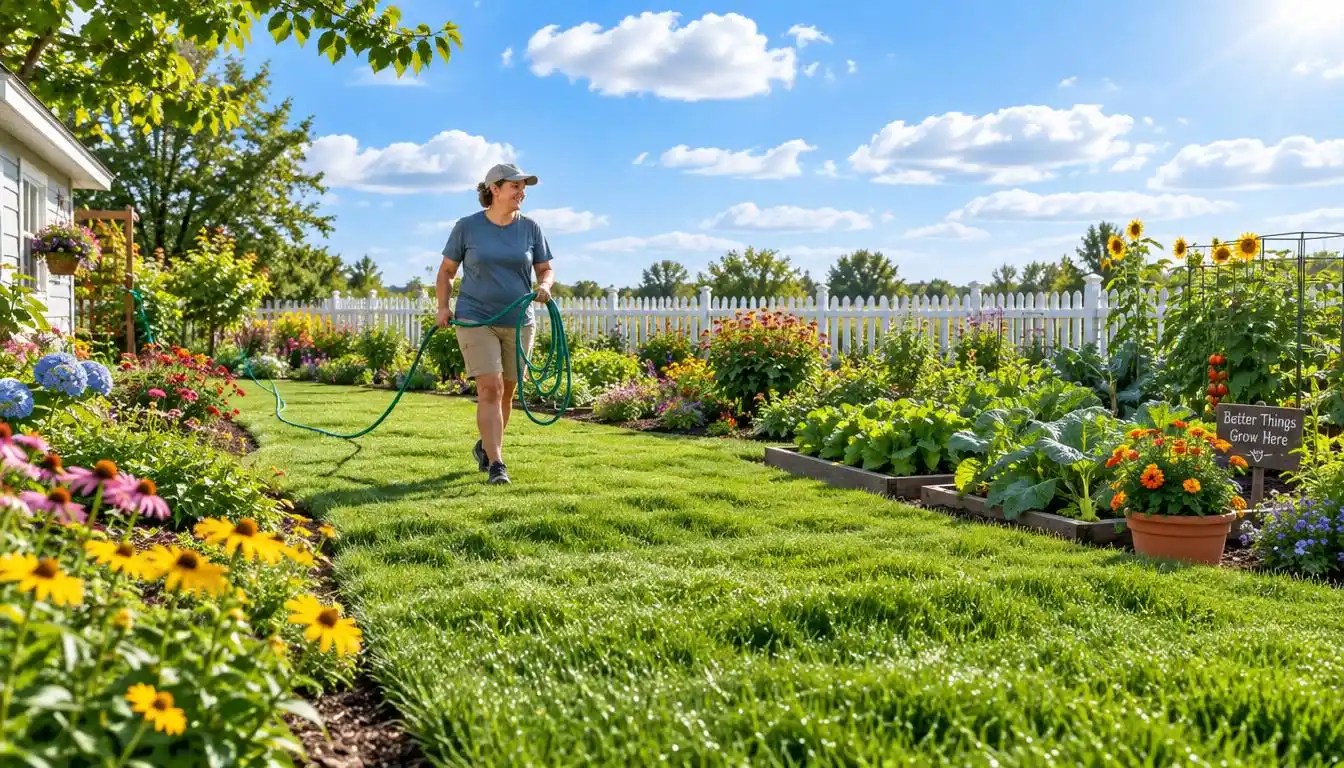
Carrying a garden hose to a few planters is simple; dragging one across a large lawn can turn watering into a chore. The best garden hose for your home depends on reach, weight, durability, and the work you need it to do.
A light hose may suit a small patio but feel less durable under daily use. A heavier hose can stand up to rough work, yet it takes more effort to move and store. Think about your plants, lawn, and summer watering routine before choosing.
Hybrid polymer is a hose material that combines polymers to stay flexible while resisting kinks. The picks below cover different yard needs, with practical advice to help you choose a useful fit.
Key Takeaways
- Flexzilla suits many everyday yards.
- zero-G is easier to carry around large spaces.
- Rubber models favor toughness or higher flow.
- Camco TastePURE has drinking-water certifications.
- Measure your route before picking a length.
What Is the Best Garden Hose for Your Yard in 2026?
For a typical yard, the Flexzilla 5/8-inch by 50-foot hose is the best all-around choice. Your best garden hose 2026 may differ if you need lighter carrying, more flow, rough-use toughness, or drinking-water certification.
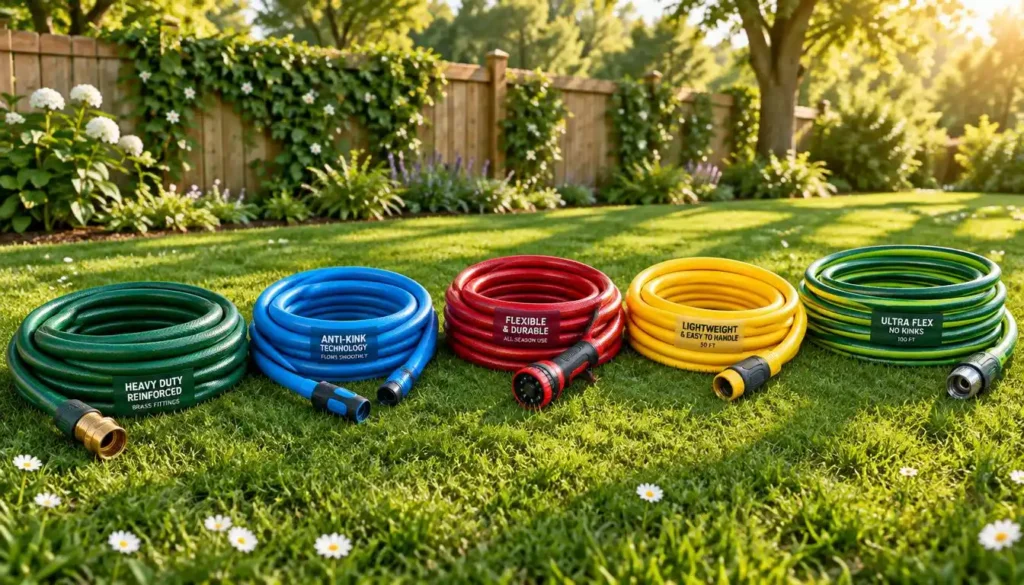
These five garden hoses serve different jobs, not a universal ranking. The picks reflect listed features and use cases, not hands-on tests conducted for this article. Compare the options by the work your yard asks of them.
Flexzilla is a practical default for everyday yard watering, but a different job can call for a different hose.
| Model | Best-for job | Yard situation |
|---|---|---|
| Flexzilla | Everyday yard watering | Typical lawn and beds |
| zero-G | Easier carrying | Large yard or frequent moves |
| Gilmour Pro Commercial | High-flow work | Long runs and sprinklers |
| Dramm ColorStorm | Rough daily use | Frequent, demanding watering |
| Camco TastePURE | Drinking-water certification | People, pets, or food plants |
For many garden hose buyers, Flexzilla balances everyday handling with useful reach. It is a sensible starting point if you water a lawn, containers, and beds without needing unusually high flow.
The lighter zero-G can help when you move a hose often. Gilmour offers a larger bore for demanding flow needs, while Dramm suits rough daily work. Camco stands out when drinking-water claims matter.
Each model has trade-offs, so the best fit depends on distance, handling, and water use. The following sections look more closely at Flexzilla and the alternatives.
Is Flexzilla the Right All-Around Hose?
Flexzilla is a strong choice for an ordinary yard, unless maximum flow on a long run comes first. The Flexzilla 5/8 inch by 50 feet model fits common watering needs and handles more easily than a heavy rubber hose.
Choose a 3/4-inch hose instead when a long run or high flow matters most. Flexzilla Garden Hose uses hybrid polymer, a material designed to stay flexible while resisting kinks. It can remain flexible in heat and cold, and it tends to lie flat rather than keep a tight coil.
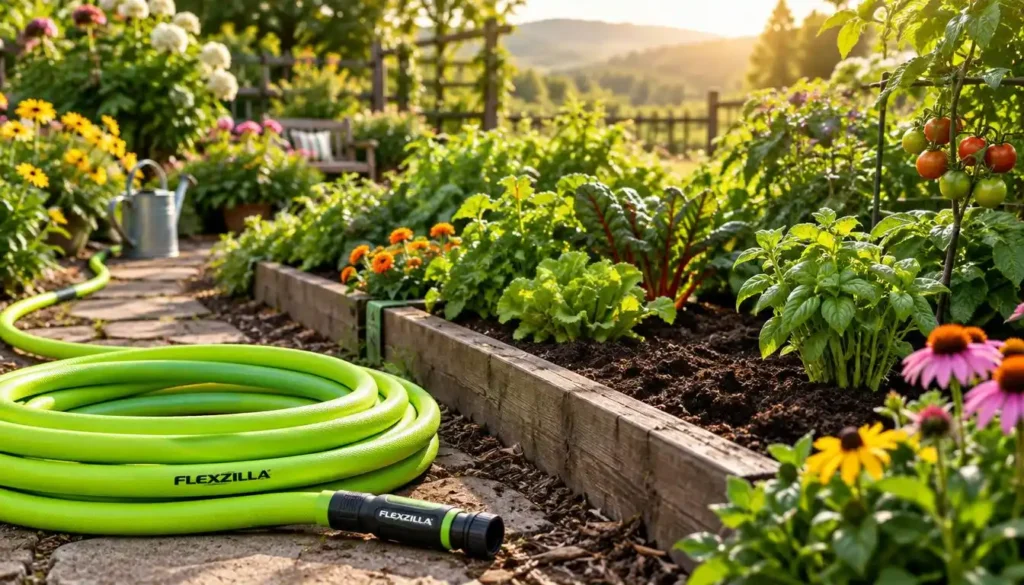
The flexible body makes it easier to carry than rubber for routine trips across the yard. It can still twist or loop as you drag it, so guide it around corners instead of pulling hard against an edge.
Its listed fittings are crush-resistant anodized aircraft aluminum with an O-ring. The product details do not state a drinking-water safety claim or warranty, so do not assume either applies.
This size works for ordinary watering, but a larger bore can better serve long runs, large containers, or sprinklers. That trade-off matters if water must travel far before reaching the task.
For many people, Flexzilla offers a useful balance of reach, flexibility, and manageable weight. If carrying a conventional hose is difficult, the lighter-weight option may be a better match.
Which Lightweight Garden Hose Is Easiest to Handle?
Carrying a long hose one-handed around a large yard is tiring, especially when you also need a tool. The zero-G 5/8-inch by 50-foot hose is easier to carry for that kind of work.
Its woven fabric jacket cuts weight by roughly half compared with a conventional hose. It uses metal couplings and does not rely on a stretching latex core, as some expandable hoses do.
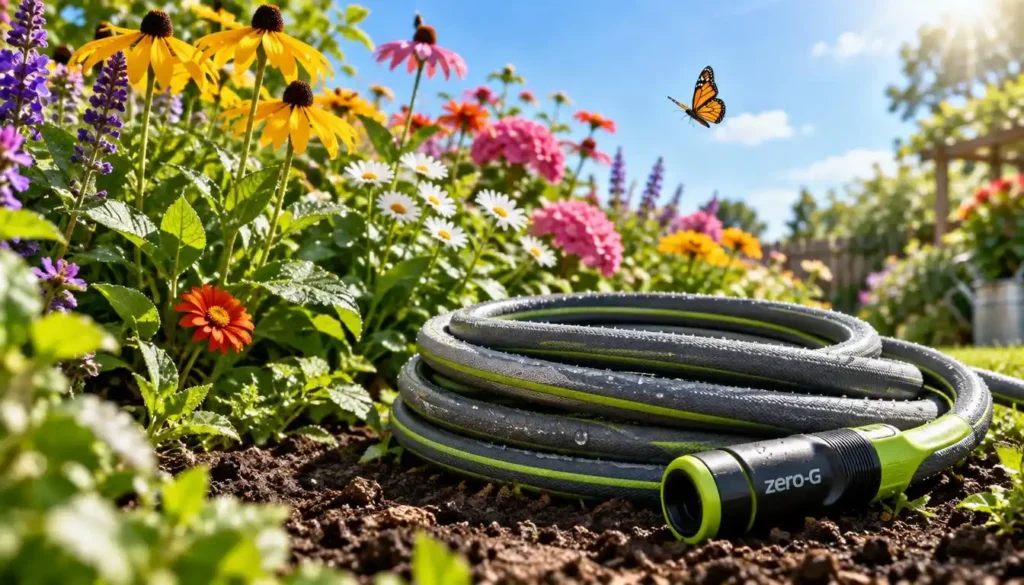
That lower weight can help if you water plants across a big yard or have a sore shoulder. It also makes it easier to pull while carrying a hand tool or moving between beds.
A fabric-covered hose makes sense on grass or mulch, where the jacket has less contact with rough ground. It is less suited to daily dragging over gravel or concrete, which can wear the fabric sooner.
Think about the route as well as the hose itself. A short trip across lawn puts less stress on the jacket than pulling it over a driveway several times each day.
For buyers who value easy handling, zero-G is a useful choice among garden hoses. If toughness matters more than low weight, compare the rubber options next.
When Is a Rubber Best Garden Hose Worth the Weight?
A hose left beside one spigot for frequent, rough work can earn its keep by taking daily use. Rubber is worth the weight when toughness or higher flow matters more than easy carrying.
Rubber hoses can be heavy and may grow stiffer as temperatures fall. Your choice depends on whether daily wear or moving the hose is the bigger concern.
Choose Dramm ColorStorm for a rubber hose built for daily use
The Dramm ColorStorm Premium is a 5/8-inch by 50-foot hose made from premium rubber. Its listing describes crush-proof, nickel-plated couplings and resistance to kinking.
It is also listed as easy to coil in cold weather and able to handle hot water up to 160 degrees Fahrenheit. The product listing includes a lifetime guarantee.
These features suit a hose that stays in regular use around the home. Rubber adds heft, though, and it may stiffen when the weather gets cold, making tight turns harder.
Choose Gilmour Pro Commercial when water flow matters most
The Gilmour Pro Commercial is a 3/4-inch by 50-foot double-reinforced rubber-and-vinyl hose. It has brass couplings, a steel spring coil at the spigot end, and a listed 400 PSI burst rating.
The larger bore suits long runs and high-flow tasks, with extra weight as the trade-off. It may work well for a sprinkler or other job where a smaller hose limits delivery.
Its size and construction make it less convenient to carry around than a light hose. Choose it when the route is demanding or flow is a regular priority, not just for occasional watering.
These models cover durability and flow needs. The next question is which hose has claims suited to people or pets drinking its water.
Which Garden Hose Should You Use for Drinking Water?
Only some hose listings make drinking-water claims, and the wording matters. Camco TastePURE lists NSF/ANSI 61 certification and CSA lead-free certification to NSF/ANSI 372.
Zero-G uses “lead safe” and “safe drinking water” language in its listing. For other picks, “not stated” means the listing makes no claim; it does not mean testing found the hose unsafe.
The Ecology Center Garden Hose Study 2016 analyzed 32 hoses. Its ten hoses labeled drinking-water safe had no significant lead, bromine, antimony, or tin, though three contained phthalates.
The two drinking-water-safe polyurethane hoses in that study contained no chemicals of concern. A label can help you narrow choices, but read what it covers instead of treating all claims as equal.
- Read the complete hose label, not just the package front.
- Prefer a whole-hose lead-free claim over one limited to couplings.
- Consider a drinking-water-safe label for kids’ water play and food plants.
- Let water run for about five seconds before use, and keep the hose shaded because heat increases leaching.
A hose used for drinking, pets, or children’s play deserves closer attention to its stated materials and certifications. Food plants also benefit from a careful choice when water contacts edible leaves or fruit.
These claims help distinguish safer-use options without making assumptions about other models. From water safety, the choice moves to the short-life trade-offs of expandable hoses.
Is an Expandable Garden Hose Right for a Small Patio?
On a small patio, a heavy hose can be awkward to carry and even harder to store. The Flexi Hose 50-foot expandable model is handy in tight spaces or for someone who cannot haul a conventional hose.
It is a convenience choice, not a buy-once hose. A latex core sits inside a fabric sleeve, then expands to full length under water pressure. The hose weighs very little and includes a multi-pattern nozzle with solid 3/4-inch brass connectors.
The listing rates the hose for 2,000 uses and water between 41 and 113 degrees Fahrenheit. Treat those as listed specifications, not a promise that every hose will last for a set number of uses.
Sun, sharp edges, and leaving the hose pressurized can shorten its service life. Drain it after use and store it in shade to help protect the latex core.
An expandable garden hose can suit a balcony, patio, or short watering route where compact storage matters. It may be a poor fit for a yard where you drag a hose over rough ground every day.
Compare convenience with expected wear before choosing among expandable garden options. Yard size and distance also affect performance, leading into the flow comparison.
How Much Flow Do You Lose on a 100-Foot Hose?
A long hose run can lose flow before water reaches a sprinkler or distant bed. For many yards, 5/8 inch is the balanced default, while 3/4 inch can suit long runs, large containers, or sprinklers.
At 100 feet, the estimates show 10.6 gallons per minute through 5/8 inch and 17.1 through 3/4 inch. The table uses an open hose end and 40 psi at the spigot while water is running.
| Hose length | 1/2-inch flow | 5/8-inch flow | 3/4-inch flow |
|---|---|---|---|
| 25 feet | 12.5 gallons per minute | 22.4 gallons per minute | 36.2 gallons per minute |
| 50 feet | 8.6 gallons per minute | 15.4 gallons per minute | 24.9 gallons per minute |
| 75 feet | 6.9 gallons per minute | 12.4 gallons per minute | 20.0 gallons per minute |
| 100 feet | 5.9 gallons per minute | 10.6 gallons per minute | 17.1 gallons per minute |
The estimates use the Hazen-Williams equation for an open hose end at 40 psi. They can overstate real flow because pressure drops as flow rises.
A nozzle or sprinkler adds resistance, too. Treat the figures as a way to compare hose sizes and lengths, not as a promise of the flow at your garden bed.
At every listed length, 3/4 inch moves about 60 percent more water than 5/8 inch. A 100-foot 5/8-inch hose delivers roughly two-thirds of the 50-foot hose’s flow.
To check your own setup, time how long the hose takes to fill a bucket of known size. That simple test includes your spigot, hose, and any end attachment.
If you are planning a best garden hose 100 ft run, compare its reach with the flow needed at the far end. Then check the other buying details that help prevent an unnecessarily long or unsuitable choice.
What Should You Compare Before Buying a Best Garden Hose?
Buying more hose than a small yard needs leaves you with extra weight to move and store. Measure the route first, then match the material and fittings to how you use it.
The shortest hose that reaches your farthest bed is often the easiest to manage. A garden hose should fit the route, not just look generous on a product page.
Match hose material to how you will use it
Materials trade weight against wear and handling. Rubber and hybrid polymer are durable choices, while a fabric build cuts weight at some cost to abrasion resistance.
| Model | Listed hose material | Measured weight per foot | Practical trade-off |
|---|---|---|---|
| Eley Polyurethane | Polyurethane | 0.15 pounds | Heavier than Zero-G and Flexzilla |
| Dramm ColorStorm Premium | EPDM rubber | 0.20 pounds | Heavier than the lighter options |
| Teknor Apex Zero-G | Tru-Flex polymer with woven fiber sheath | 0.08 pounds | Fabric jacket is less suited to abrasion |
| Flexzilla 5/8-Inch | Flexible hybrid polymer | 0.13 pounds | Can twist or loop while being dragged |
Expandable hoses with latex cores are a convenience choice rather than a buy-once option. Eley and Dramm weigh more per foot than the listed Zero-G and Flexzilla models.
Measure the distance before choosing hose length
Measure from the spigot to the farthest bed along the route the hose will follow. Buy the shortest length that reaches, then round up one size for turns and movement.
Two 50-foot hoses coupled together can be easier to handle than one 100-foot hose. You can use one length for nearby work, then connect the second only when the far end needs water.
A longer hose adds weight and can make storage harder. A best garden hose choice should reach the last bed without leaving a large coil in the yard.
Check the coupling material and listed specifications
Metal couplings generally resist crushing and cross-threading better than plastic ones. Still, check the maker’s actual claims because materials and fittings vary across models.
Check bore, length, fitting material, water-safety labels, and warranty details on the exact model. Similar names do not guarantee the same construction or claims.
- Measure the real route from spigot to bed.
- Choose the minimum workable length.
- Match material to how often and where you drag it.
- Inspect fitting material and any water-safety label.
That short checklist can keep a garden hose purchase tied to real work instead of extra reach you rarely use. Once you have chosen the hose, consider the nozzle at its end.
Which Garden Hose Nozzle Is Worth Upgrading?
A plastic nozzle can crack after a drop even when your hose still works well. The FANHAO all-metal nozzle is a practical upgrade for a watering setup that needs a tougher outlet.
Its zinc-alloy body, rubber O-ring washers, squeeze trigger, and twist-adjust tip are built for everyday control. Turn the tip to shift from a soft shower to a focused jet.
The metal body may better handle an accidental fall than a plastic nozzle that can crack. Its one-year guarantee covers defects in materials and workmanship.
A best garden hose nozzle helps you direct water where it belongs, from tender plants to a rinse task. It does not increase the hose’s underlying flow capacity or fix low pressure.
Choose the spray that suits the work, then shut off the water at the spigot when you finish. The next question is how to keep the hose itself out of the way between uses.
Does a Retractable Hose Reel Solve Storage Clutter?
A hose that crosses the lawn can end up in a heap or stretched across the yard after watering. A wall-mounted reel is useful for clutter if you want the hose stored in one place.
The Giraffe Tools retractable reel holds a 130-foot, 1/2-inch hose and rewinds with a tug. Its case protects the stored hose from sun and frost.
The unit swivels on its mount and includes a 5-foot lead hose with 3/4-inch garden-hose thread. Its listed warranty lasts two years, while the coupling material is not stated.
The 1/2-inch hose favors reach for beds and light tasks rather than high-flow work. It can suit a yard where neat storage matters more than moving large amounts of water.
If hose clutter is your main frustration, this may be the best garden hose reel style for your setup. Check that its reach covers the areas you water before mounting it.
Storage convenience solves one problem, but careful habits help any hose resist kinks and last longer.
How Do You Prevent Kinks and Extend Hose Life?
Leaving a hose attached to a spigot as freezing weather approaches can cause damage. Water left inside can split the hose or couplings as it freezes and expands.
Drain the hose and disconnect it before a hard freeze. Kinking, sun, and rough dragging can also wear a hose or cause a split near its coupling.
Keep the hose clear of pressure, freezing water, and direct sun
Use a simple routine to reduce common causes of early wear. A little care also makes the hose easier to handle when you water again.
- Drain the hose and disconnect it from the spigot before a hard freeze.
- Coil it on a hanger or reel and keep it out of direct sun.
- Do not leave it pressurized with the nozzle shut between uses.
- Keep it off the ground where a mower or repeated kinking can damage it.
Direct sun ages hose covers and can be especially hard on expandable-hose latex cores. Shade can also reduce heat-related leaching concerns when you use water for drinking.
Keep the hose away from sharp edges and avoid pulling it around tight corners. Repeated kinking puts stress on the same spot and can weaken it over time.
Check the coupling washer before replacing the hose
A leak at the spigot or nozzle may come from a worn or missing rubber washer inside the female coupling. The washer forms the seal between the hose and the fitting.
Replacing that washer and hand-tightening the coupling may stop a leak without replacing the hose. Check the washer first if water sprays from the connection while the hose body stays dry.
A clean coil and sound washer can prevent small problems from turning into a replacement job. If you still need a model for specialized work, match its features to the task.
What Best Garden Hose Works for Professional Use?
What garden hose professionals use depends on the job, not a single universally preferred model. Match the hose to the work, because long-distance flow, rough use, and frequent movement call for different traits.
A larger bore can suit long runs and high-flow tasks, while heavy rubber can suit rough, stationary use. A flexible hybrid hose may be easier to move around beds.
Choose for the task, not a broad label: distance, flow demand, and how often you move the hose all matter.
A reliable like-for-like comparison with Uberflex is not clear from its product details. Before choosing Uberflex or Flexzilla, compare the exact models’ bore, length, fitting material, warranty, and stated use.
Product names alone do not tell you how a hose will work on your site. A landscaper watering fixed beds may value different features than someone dragging a hose around a large property.
- Match diameter to distance and flow demand.
- Choose a material that suits how often the hose will be moved.
- Check coupling construction and warranty terms.
Use those checks for professional work or demanding home tasks. Start with the longest run and heaviest regular job, then choose the model that fits both.
Conclusion
Start with the task your hose must handle most often. Flexzilla is a sensible default for many ordinary yards, while a light, rubber, high-flow, expandable, or drinking-water-safe model may better fit a specific need.
Think about the longest route and the hardest regular use before settling on a size. Measure from the spigot to the farthest bed, then choose the shortest hose that fits that route.
Table of Contents
FAQ
What kind of best garden hose lasts the longest?
Rubber and hybrid polymer hoses with metal fittings can last a decade or more with basic care. That is a possibility, not a fixed lifespan promise, since use and storage affect wear. Drain the hose before freezing weather, keep it shaded, and avoid repeated kinks. Check washers when a connection leaks before replacing the full hose.
Which type of best garden hose is better, rubber or vinyl?
Rubber is tougher but heavier, and it can stiffen in cold weather. Vinyl is lighter, but it is more prone to kinking and sun-related wear. Choose rubber for frequent rough use when you can manage the weight. Vinyl may suit lighter jobs where easy movement matters more than long-term toughness.
Is Flexzilla the best garden hose?
Flexzilla is a strong general-purpose choice, but it is not best for every need. Its hybrid polymer body offers flexible handling for everyday watering. Choose zero-G if carrying weight is your main concern, Gilmour Pro Commercial for higher-flow work, or Camco TastePURE when drinking-water claims matter. Your route and regular tasks should guide the choice.
What are the top 5 best garden hose?
Five strong options are Flexzilla, zero-G, Gilmour Pro Commercial, Dramm ColorStorm, and Camco TastePURE. Flexzilla fits everyday watering, while zero-G is easier to carry. Gilmour suits high-flow work, and Dramm is built for rough daily use. Camco is the choice to consider when drinking-water certification matters.
What is the difference between Flexzilla and Flexzilla Pro?
The listed product details do not establish the differences between the Flexzilla and Flexzilla Pro lines. Names alone may not show changes in build or intended use. Compare the exact model’s material, diameter, fittings, and warranty before buying. Check the package or product listing for the specific version you are considering.
Why does my Flexzilla best garden hose get sticky?
The product details do not confirm a Flexzilla-specific cause for a sticky surface. Check for residue and signs of surface wear or deterioration, but do not assume a known defect. Clean only as the maker directs, and contact the manufacturer if the hose remains sticky or its surface appears damaged.
Is Flexzilla made in the USA?
The product details do not establish Flexzilla’s country of manufacture. Check the package or the manufacturer’s information for the exact model, since product lines can include different versions. Do not infer where a hose was made from its brand name or the place where you bought it.